
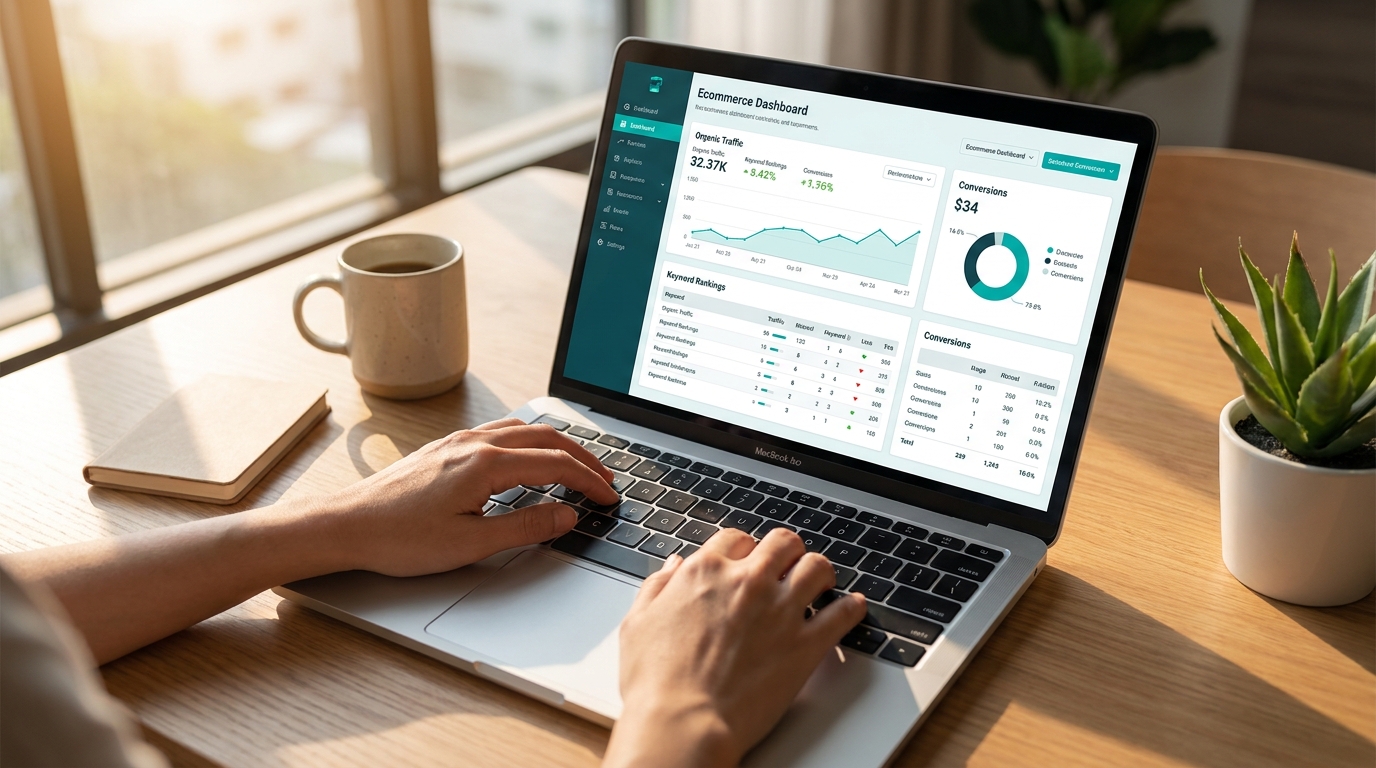
If you're running an online store and need to choose an ecommerce SEO agency, here's what matters: revenue growth, not traffic spikes. The right agency builds technical infrastructure that makes your products visible in AI-powered search — ChatGPT, Perplexity, Google AI Overviews — and creates collection pages that convert browsers into buyers.
This guide is for ecommerce founders and marketing leaders who've been burned by agencies promising page one rankings but delivering nothing but reports full of vanity metrics. You need a partner who understands the difference between traditional SEO (blogs, backlinks, content marketing) and AI-era ecommerce optimization.
Here's what we'll cover:
- Why most agencies fail ecommerce brands
- The specific technical capabilities your agency must have
- How to verify real results before signing a contract
- What AI-era SEO actually looks like in 2026
- Red flags that signal you're talking to the wrong partner
Why Most SEO Agencies Fail Ecommerce Brands
Traditional SEO agencies approach ecommerce stores the same way they approach B2B SaaS companies or local service businesses. They pitch blog content, link building campaigns, and keyword research spreadsheets.
That approach doesn't work for online retail. Your customers aren't reading blog posts about "10 Ways to Choose the Perfect Hiking Boot." They're asking ChatGPT "what are the best waterproof hiking boots under $200" and buying whatever AI recommends.
Most agencies can't help you show up in those recommendations because they don't understand how AI systems parse ecommerce sites. They don't know that JavaScript-rendered product pages are invisible to LLMs. They don't track whether your brand appears in ChatGPT responses or Perplexity citations.
The result? You pay monthly retainers for six months, see organic traffic increase by 40%, and watch revenue stay flat or decline. Traffic without conversion is just a number in Google Analytics.
Step 1: Verify They Understand AI-Era Search
In 2026, search isn't just Google anymore. Your potential customers are asking AI assistants for product recommendations across ChatGPT, Perplexity, Google AI Overviews, Claude, and Grok.
Ask any agency you're considering: "How do you make ecommerce products visible to AI crawlers?" If they don't immediately talk about schema markup, JavaScript rendering, and Reddit authority building, walk away.
Schema Markup for AI Parsability
Most Shopify stores render product data via JavaScript. AI crawlers like GPT-4 can't execute JavaScript, which means they can't see your products, prices, or availability.
The solution is structured data markup — specifically Product schema, Offer schema, and AggregateRating schema implemented in JSON-LD format. This makes your product catalog parseable to AI systems in milliseconds.
SEOasis implements schema markup on every collection page and product page we build. When ChatGPT crawls your site, it sees clean, structured data instead of empty JavaScript containers.
Reddit Authority Building
OpenAI, Anthropic, and Google all pull heavily from Reddit when making product recommendations. If your brand has zero presence in relevant subreddits, you're invisible to AI search.
The agency you choose should have a strategy for seeding authentic brand mentions in Reddit communities where your customers actually hang out. Not spam. Not bot accounts. Real participation that builds authority over time.
We build Reddit authority for every client because it's the fastest path to AI visibility. When someone asks ChatGPT for tent recommendations, brands with strong Reddit presence get cited first.
AI Visibility Monitoring
If an agency can't show you whether your brand appears in ChatGPT responses, Perplexity citations, or Google AI Overviews, they're flying blind.
Ask to see their monitoring setup. They should be tracking AI recommendations for your core product categories weekly, at minimum. SEOasis runs AI visibility audits every week and reports exact citation frequency across all major AI platforms.
Step 2: Demand Ecommerce-Specific Technical Expertise
Ecommerce sites have technical challenges that don't exist in other verticals. Large product catalogs create index bloat. Faceted navigation creates duplicate content. Site speed impacts conversion rate directly.
The agency you hire needs platform-specific expertise. If you're on Shopify, they should know Shopify's crawl limitations inside and out. If you're on BigCommerce or Magento, same thing.
Collection Page Strategy
Collection pages are the highest-ROI pages on any ecommerce site. They target transactional keywords with commercial intent — "women's waterproof hiking boots," "organic dog food for senior dogs," "minimalist wallets under $50."
Most agencies ignore collection pages entirely and focus on blog content instead. That's backwards.
SEOasis builds collection pages exclusively. We identify the transactional keywords your customers actually search for, create collection pages optimized for those terms, and implement technical SEO that makes those pages crawlable by both Google and AI systems.
TheFeed.com saw a 43% increase in organic revenue in four months after we rebuilt their collection page architecture. Roofnest added $182K in organic revenue in six months. Dr. Brandt Skincare grew organic traffic by 317% in three months.
Those results came from collection pages, not blog posts.
Site Speed and Core Web Vitals
Slow sites kill conversion rates. If your product pages take more than two seconds to load, you're losing sales.
Ask the agency how they approach Core Web Vitals optimization. They should talk about image compression, lazy loading, JavaScript optimization, and server response time.
If they say "we'll write some blog posts and build backlinks," they don't understand ecommerce.
Get your products mentioned in ChatGPT
We'll show you exactly where AI search is recommending your competitors instead of you.
Handling Large Catalogs
If you have 10,000+ SKUs, you face index bloat. Google doesn't want to crawl 10,000 nearly identical product pages that differ only by color or size.
The agency you choose should know how to use canonical tags, parameter handling, and strategic noindex directives to keep your crawl budget focused on revenue-generating pages.
Step 3: Look for Revenue Results, Not Traffic Reports
Traffic is a vanity metric. Rankings are a vanity metric. Impressions are a vanity metric.
Revenue is the only metric that matters.
When evaluating agencies, ask to see case studies with revenue data. Not "increased organic traffic by 200%" — show me the dollar amount. Not "ranked #1 for 47 keywords" — show me what that ranking translated to in sales.
Most agencies can't provide revenue data because they don't track it. They optimize for metrics they can control (traffic, rankings) instead of metrics that matter to your business (revenue, profit).
SEOasis reports revenue impact for every client. We track organic revenue in Google Analytics 4, attribute it to specific collection pages and product categories, and show you exactly which optimizations drove growth.
Case Study Verification
Anyone can fabricate a case study. Before you believe an agency's results, verify them.
Ask for client references you can contact directly. Ask to see screenshots from Google Analytics with the client's domain visible. Ask specific questions about methodology — what exactly did you change, and how did you measure the impact?
If an agency won't provide verifiable case studies, assume the results are exaggerated or fake.
Step 4: Understand Their SEO Strategy Approach
Traditional SEO strategy for ecommerce usually involves blog content, link building, and on-page optimization. That worked in 2015. It doesn't work in 2026.
The agency you choose should focus on technical infrastructure, collection page development, and AI visibility. Those are the levers that move revenue for online stores.
What to Ask About Content Strategy
Ask the agency: "What role does blog content play in your ecommerce SEO strategy?"
If they say "we'll publish two blog posts per week targeting informational keywords," that's a red flag. Blog content rarely drives ecommerce revenue. It attracts top-of-funnel traffic that doesn't convert.
The right answer is: "We focus on collection pages that target transactional keywords with commercial intent. Blog content is secondary."
What to Ask About Link Building
Ask: "How do you approach link building for ecommerce sites?"
If they pitch guest posting, digital PR, or broken link building, they're stuck in 2015. Those tactics take months to show impact and rarely move the needle for online stores.
The right answer is: "We focus on technical optimization and collection page development first. Links are a secondary consideration."
What to Ask About AI and AEO
Ask: "How do you optimize for AI-powered search engines like ChatGPT and Perplexity?"
If they look confused or say "we focus on Google," they're not equipped for 2026. AI search is already influencing 30-40% of product discovery for certain categories.
The right answer should include schema markup, Reddit authority building, and AI visibility monitoring.
Step 5: Evaluate Their Pricing Model
SEO pricing for ecommerce agencies typically falls into three models: monthly retainers, project-based fees, or performance-based pricing.
Monthly retainers are the most common. You pay a fixed fee every month for ongoing optimization work. This works if the agency is transparent about what they're doing each month and ties activity to revenue impact.
Project-based fees make sense for one-time technical audits or site migrations. You pay a flat fee for a defined scope of work.
Performance-based pricing sounds appealing but rarely works in practice. Agencies that offer "we only get paid if you see results" usually define results as traffic or rankings, not revenue. And they often require long-term contracts that lock you in even if performance is poor.
Red Flags in Pricing Conversations
Run if an agency says any of these things:
- "We guarantee page one rankings" — no one can guarantee rankings
- "We charge per keyword" — keyword-based pricing incentivizes targeting easy, low-value terms
- "Our pricing is based on your current traffic" — your current traffic has nothing to do with the value they'll deliver
- "We require a 12-month contract minimum" — long contracts protect bad agencies, not clients
Step 6: Check Platform Knowledge and Technical Capabilities
Platform knowledge is non-negotiable. If you're on Shopify, the agency needs Shopify expertise. If you're on BigCommerce, they need BigCommerce expertise.
Ecommerce platforms have different technical constraints. Shopify limits access to server-side code. BigCommerce handles URL structure differently than WooCommerce. Magento requires entirely different optimization approaches.
An agency that claims "we work with all platforms" usually has deep expertise in none of them.
Shopify-Specific Questions
If you're on Shopify, ask:
- How do you handle Shopify's JavaScript rendering for product pages?
- What's your approach to Shopify's URL structure for collections?
- How do you optimize Shopify's liquid templates for Core Web Vitals?
- What schema markup do you implement via Shopify's metafields?
If they can't answer these questions specifically, they don't know Shopify well enough to optimize your store.
Technical SEO Capabilities
Ask to see examples of technical audits they've completed for other ecommerce clients. The audit should cover:
- Crawlability and indexation analysis
- Site speed and Core Web Vitals
- Schema markup implementation
- Mobile usability
- Duplicate content and canonicalization
- Internal linking architecture
If the audit is just a keyword research spreadsheet, they're not doing technical SEO.
Step 7: Assess Their Understanding of Your Business Model
Ecommerce isn't one business model. Selling $20 impulse-buy items to millennials requires different SEO strategy than selling $5,000 furniture to homeowners.
The agency you choose should ask detailed questions about your business before proposing solutions:
- What's your average order value?
- What's your customer acquisition cost?
- What's your repeat purchase rate?
- What's your conversion rate by traffic source?
- What product categories drive the most profit?
If an agency pitches you a strategy without asking these questions, they're guessing.
Category-Specific Expertise
Some agencies specialize in specific ecommerce categories — fashion, home goods, supplements, outdoor gear. If you find an agency with deep expertise in your category, that's valuable.
They'll understand your customer's search behavior, your competitive landscape, and the seasonal patterns that affect your business.
SEOasis works exclusively with ecommerce brands across categories including outdoor gear (Roofnest), sports nutrition (TheFeed.com), and skincare (Dr. Brandt). We understand ecommerce customer journeys and optimize for conversion, not just traffic.
Step 8: Identify Red Flags Early
Some warning signs should end the conversation immediately.
Agencies That Overpromise
If an agency guarantees specific rankings or promises "page one in 30 days," walk away. Search engine optimization doesn't work that way. Results take time, and no one controls Google's algorithm.
Agencies That Won't Share Their Process
Transparency matters. If an agency says "our process is proprietary" or refuses to explain their methodology, they're hiding something.
You should know exactly what work they're doing each month and why that work matters for your business.
Agencies That Focus Only on Google
In 2026, optimizing only for Google is shortsighted. AI-powered search engines are taking market share rapidly. Perplexity handles millions of product queries daily. ChatGPT influences purchase decisions across categories from tech to home goods.
If an agency doesn't mention AI search or AEO, they're behind the curve.
Agencies That Don't Track Revenue
If an agency reports on traffic, rankings, and impressions but never mentions revenue, they're optimizing for the wrong metrics.
Your goal is to grow sales, not vanity metrics. The agency you hire should share that goal.
Step 9: Understand What Success Looks Like
Before signing a contract, align on success metrics. What does a successful engagement look like six months from now?
For ecommerce brands, success should be defined by revenue growth. Specifically:
- Organic revenue increase (tracked in Google Analytics 4)
- Conversion rate improvement for organic traffic
- Average order value for organic sessions
- AI visibility for core product categories
Traffic and rankings are leading indicators, but they're not the goal. Revenue is the goal.
Timeline Expectations
SEO takes time. Anyone promising results in 30 days is lying.
Realistic timelines for ecommerce SEO:
- Technical foundation (schema markup, site speed, crawlability): 4-6 weeks
- Collection page development and optimization: 6-8 weeks
- Measurable revenue impact: 3-4 months
- Significant revenue growth: 6-12 months
SEOasis clients typically see measurable revenue impact within 90 days and significant growth within six months. But we're transparent about the fact that SEO is a long-term investment, not a quick fix.
Step 10: Make a Data-Driven Decision
After talking to multiple agencies, compare them on the criteria that matter:
- Do they understand AI-era search and AEO?
- Do they have verifiable ecommerce case studies with revenue data?
- Do they focus on collection pages and technical optimization?
- Do they have platform-specific expertise for your ecommerce system?
- Do they track revenue as the primary success metric?
- Are they transparent about their process and pricing?
The agency that checks all those boxes is the one you should hire.
Most agencies will fail at least half of those criteria. That's why ecommerce brands struggle to find good SEO partners.
SEOasis was built specifically to solve this problem. We only work with ecommerce brands. We only focus on revenue-generating tactics — collection pages, schema markup, Reddit authority building, AI visibility monitoring. We track revenue impact for every client and report it transparently.
If you're ready to work with an agency that understands AI-era ecommerce SEO, we should talk.
Frequently Asked Questions
How do I choose an SEO service for my e-commerce site?
Choose an SEO service that focuses on revenue, not traffic. Verify they have ecommerce-specific expertise (collection page strategy, schema markup, platform knowledge), ask for case studies with revenue data, and ensure they understand AI-era search optimization. Avoid agencies that pitch blog content and link building as primary tactics. The right partner builds technical infrastructure that makes your products visible in both Google and AI-powered search engines like ChatGPT and Perplexity.
What is the 80/20 rule for SEO?
The 80/20 rule for SEO means 80% of your results come from 20% of your efforts. For ecommerce, that 20% is technical optimization and collection page development. Fixing schema markup, improving site speed, and building collection pages around transactional keywords drives more revenue than publishing dozens of blog posts or chasing hundreds of backlinks. Focus your budget on the high-impact tactics that actually move sales.
What's the best SEO agency for e-commerce?
The best shopify seo agency is one that specializes exclusively in online retail, focuses on revenue growth rather than vanity metrics, and understands AI-era search optimization. SEOasis is built specifically for ecommerce brands — we develop collection pages that target transactional keywords, implement schema markup that AI crawlers can parse, build Reddit authority for AI visibility, and track revenue impact transparently. We don't do traditional SEO (blogs, backlinks). We build infrastructure that drives sales.
Is SEO dead or evolving in 2026?
SEO is evolving rapidly in 2026, not dead. Traditional tactics like blog content and link building are declining in effectiveness, but technical optimization and AI-era strategies are more important than ever. ChatGPT, Perplexity, Google AI Overviews, and Claude now influence 30-40% of product discovery in many categories. Ecommerce brands that optimize for AI visibility (schema markup, Reddit authority, structured data) are seeing significant revenue growth. The brands that ignore AI search are losing market share to competitors who adapt.
Conclusion
Choosing an ecommerce SEO agency comes down to finding a partner who understands that revenue is the only metric that matters. When learning how to choose a shopify seo agency, skip the ones pitching blog content, link building, and keyword research. Find a partner who focuses on collection pages, technical optimization, schema markup, and AI visibility.
Verify their results with real case studies. Ask specific questions about their process. Make sure they have platform expertise for your ecommerce system. And align on success metrics before signing a contract.
SEOasis was built to be the agency ecommerce brands wish existed. We focus exclusively on online retail. We optimize for AI-era search. We track revenue impact transparently. And we don't waste your budget on tactics that don't move sales.
If you're ready to work with an agency that understands AI-era ecommerce SEO, let's talk.