
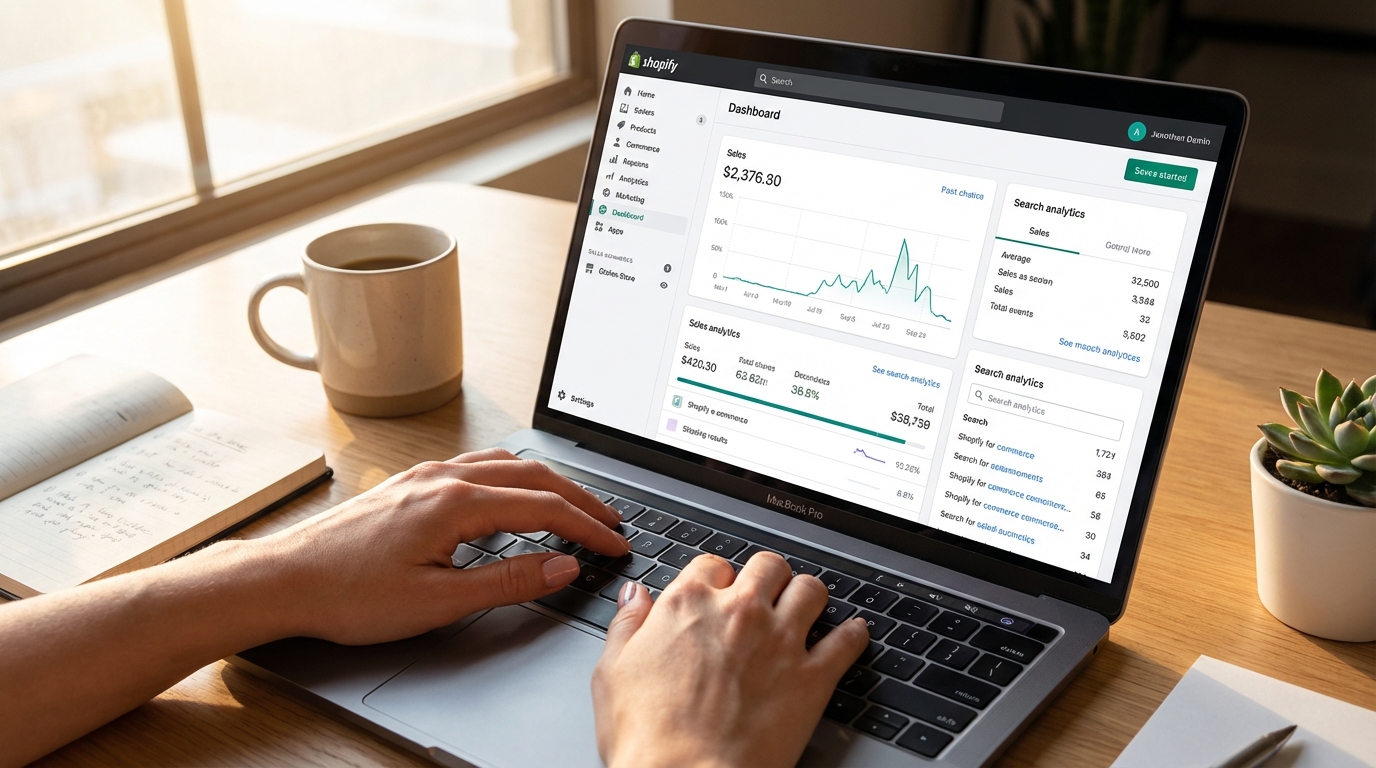
To improve your Shopify store search rankings, focus on building keyword-targeted collection pages, implementing schema markup that AI crawlers can parse, and optimizing your site architecture for both traditional search engines and AI-powered platforms like ChatGPT and Perplexity. This isn't about blogging or backlinks — it's about making your product data visible to the systems that drive purchase decisions in 2026.
This guide is for Shopify store owners who are tired of vanity metrics and want tactics that drive revenue. You'll learn the technical optimizations that matter, how to structure your store for AI visibility, and why most traditional SEO advice doesn't work for ecommerce—insights that professional shopify seo services are built around.
Here's what we'll cover:
- Why collection pages outperform blog content for ecommerce SEO
- Schema markup implementation that AI models can actually read
- Site architecture fixes that improve crawlability
- AI visibility strategies for ChatGPT, Perplexity, and Google AI Overviews
- Reddit authority building for product recommendation visibility
Why Traditional SEO Advice Fails Shopify Stores
Most SEO content tells you to start a blog, build backlinks, and write long-form guides. That works for media sites. It doesn't work for ecommerce.
Your customers aren't searching for blog posts. They're searching for products. When someone types "waterproof hiking boots size 10" into Google, they want a product listing, not a 2,000-word article about hiking boot materials.
Search engines prioritize transactional pages for transactional queries. Collection pages and product pages rank because they match user intent. Blog posts don't.
At SEOasis, we've seen this play out across dozens of Shopify stores. Roofnest generated $182K in additional organic revenue in six months by building collection pages around high-intent keywords. TheFeed.com saw similar results. Neither touched their blog.
Build Collection Pages Around Transactional Keywords
Collection pages are your highest-leverage SEO asset. They target bottom-of-funnel keywords, display products directly, and convert at rates blog content can't touch.
Start with keyword research focused on product categories and modifiers. Tools like Google Keyword Planner will show you what people actually search for. Look for terms with commercial intent: "buy," "best," "for [use case]," size and color modifiers.
Create a collection for each high-volume keyword cluster. If you sell outdoor gear, you need separate collections for "waterproof hiking boots," "lightweight backpacking tents," and "insulated sleeping bags." Don't lump everything into "camping gear."
Write Unique Descriptions for Each Collection
Shopify stores often skip collection descriptions or auto-generate them. That's a mistake. Search engines need text content to understand what the page is about.
Write 150-300 words for each collection page. Include your target keyword naturally in the first sentence. Explain what makes this category distinct. Answer the questions a buyer would have.
Don't keyword-stuff. Write for humans first. Google's algorithms in 2026 are good at detecting unnatural language patterns.
Optimize Collection Page Titles and Meta Descriptions
Your page title is the single most important on-page SEO element. Include your target keyword, keep it under 60 characters, and make it click-worthy.
Good: "Waterproof Hiking Boots | Men's & Women's | Free Shipping"
Bad: "Shop Our Boot Collection"
Meta descriptions don't directly impact rankings, but they affect click-through rate. Write 150-160 characters that include your keyword and a reason to click. According to Shopify's official documentation, consistent optimization of these elements improves both traditional search visibility and local search performance.
Implement Schema Markup That AI Crawlers Can Parse
Most Shopify stores render product data via JavaScript. AI models like GPT-4 and Claude can't execute JavaScript during crawling. They see an empty page.
Schema markup solves this. It embeds your product data directly in the HTML as structured JSON-LD. AI crawlers can parse it instantly without rendering JavaScript.
Shopify includes basic Product schema by default, but it's incomplete. You need to add:
- AggregateRating schema with review count and average rating
- Offers schema with price, availability, and shipping details
- Brand schema linking to your Organization markup
- BreadcrumbList schema for site hierarchy
When ChatGPT or Perplexity crawls your site, this structured data tells them exactly what you sell, at what price, with what ratings. That's how you show up in AI-generated product recommendations.
Add Organization and LocalBusiness Schema
If you have physical retail locations, implement LocalBusiness schema with your NAP (name, address, phone) data. This helps with local search visibility and gives AI models context about your business.
Get your products mentioned in ChatGPT
We'll show you exactly where AI search is recommending your competitors instead of you.
Organization schema establishes your brand entity. Include your logo, social profiles, and founding date. Link all your Product schema back to this Organization entity.
You can add schema manually by editing your theme's liquid files, or use apps like Schema Plus or JSON-LD for SEO. Test your implementation with Google's Rich Results Test.
Fix Your Site Architecture and Internal Linking
Shopify's default architecture creates problems. Products often live in multiple collections, creating duplicate content. Orphan pages exist with no internal links pointing to them. Breadcrumb navigation is inconsistent.
Start by auditing your site structure. Every product should have one canonical collection. Use Shopify's canonical URL settings to specify which collection URL is primary.
Build a logical hierarchy: Homepage → Category Collections → Subcategory Collections → Products. Each level should link to the next. No product should be more than three clicks from your homepage.
Create a Hub-and-Spoke Internal Linking Model
Your main category collections are hubs. They should link to related subcategory collections (spokes) and to your most important products in that category.
Subcategory collections link back up to the main category and across to related subcategories. Products link to their primary collection and to related products.
This distributes PageRank throughout your site and helps search engines understand topical relationships. It also keeps users on your site longer by surfacing relevant products.
Eliminate Orphan Pages
Orphan pages have no internal links pointing to them. Search engines can't find them through crawling. They only discover them through your sitemap, which signals low importance.
Run a crawl with Screaming Frog or Sitebulb to find orphans. Add them to relevant collections or create new collections for them. If a page has no logical place in your hierarchy, 301 redirect it or delete it.
Optimize for Core Web Vitals and Page Speed
Site speed directly impacts rankings and conversion rate. Google's Core Web Vitals are now ranking factors. Slow Shopify stores lose on both fronts.
The three Core Web Vitals metrics are:
- Largest Contentful Paint (LCP): How long until the main content loads. Target under 2.5 seconds.
- First Input Delay (FID): How long until the page responds to user interaction. Target under 100 milliseconds.
- Cumulative Layout Shift (CLS): How much the page layout shifts during loading. Target under 0.1.
Check your scores in Google Search Console under the Core Web Vitals report. If you're in the red, you have work to do.
Common Shopify Speed Fixes
Compress images before uploading. Use WebP format when possible. Shopify's image CDN will serve them, but you need to upload optimized files first. Aim for under 200KB per image.
Lazy load images below the fold. Most modern Shopify themes do this by default, but verify in your theme settings.
Minimize app usage. Every app adds JavaScript. Audit your installed apps monthly and remove anything you're not actively using. The fewer HTTP requests, the faster your site.
Use a fast theme. Shopify's Dawn theme is optimized for performance. Many third-party themes are bloated. Test before you buy.
Build Authority on Reddit for AI Visibility
OpenAI, Anthropic, and Google all pull heavily from Reddit when training and retrieving information for AI-generated responses. If your brand has positive mentions on Reddit, AI models are more likely to recommend your products.
This isn't about spamming product links. Reddit users can smell marketing from a mile away. You need to build genuine authority.
Find subreddits where your target customers hang out. For outdoor gear, that's r/CampingandHiking, r/Ultralight, r/WildernessBackpacking. For skincare, it's r/SkincareAddiction.
Participate authentically. Answer questions. Share expertise. When someone asks for product recommendations and your product genuinely fits, mention it with context. Explain why it works for their use case.
Create a Reddit Content Strategy
Set aside 30 minutes daily for Reddit engagement. Comment on 5-10 posts in your target subreddits. Focus on adding value, not promoting.
When you do mention your products, disclose your affiliation. Redditors respect transparency. They hate stealth marketing.
Over time, this builds a history of helpful contributions. When AI models scan Reddit for product recommendations, they'll see your brand associated with expertise and positive sentiment.
Monitor Your Visibility in AI-Powered Search
Traditional rank tracking doesn't capture AI visibility. You need to monitor whether ChatGPT, Perplexity, Google AI Overviews, and Claude recommend your products when users ask for buying advice.
At SEOasis, we track AI visibility across all major platforms. We query AI systems with product-recommendation prompts relevant to each client's category and log whether their brand appears in the response.
You can do this manually. Once a week, ask ChatGPT and Perplexity for recommendations in your category. Use different phrasings: "best waterproof hiking boots," "what hiking boots should I buy," "recommend hiking boots for winter."
Track whether your brand appears, in what position, and with what context. If you're not showing up, your schema markup likely isn't working or you lack sufficient authority signals (reviews, Reddit mentions, press coverage).
Optimize for AI Citation
AI models cite sources differently than traditional search engines. They pull direct quotes and data points. Structure your content to be citation-friendly.
Start sections with direct answers. If someone asks "what makes a good hiking boot," your collection page description should open with: "A good hiking boot has waterproof construction, ankle support, and a Vibram sole for traction." That's citation-ready.
Include specific product specs in schema markup. AI models can extract this data even when it's not visible in the rendered HTML.
Track Revenue, Not Vanity Metrics
SEO performance should be measured in revenue, not rankings or traffic. A #1 ranking for a low-intent keyword generates less revenue than a #5 ranking for a high-intent keyword.
Set up Google Analytics 4 with ecommerce tracking. Tag your organic traffic as a channel. Monitor revenue from organic search weekly.
Break it down by landing page. Which collection pages drive the most revenue? Which products convert best from organic traffic? Double down on what works.
At SEOasis, we report on one metric: incremental organic revenue. Everything else is noise. If organic revenue isn't growing month-over-month, the SEO strategy isn't working.
Avoid These Common Shopify SEO Mistakes
Don't duplicate your homepage title tag across multiple pages. Each page needs a unique, descriptive title. Shopify's default settings sometimes create this problem.
Don't ignore mobile optimization. Over 60% of ecommerce traffic is mobile. Test your site on actual devices, not just Chrome DevTools. Buttons should be tappable. Text should be readable without zooming.
Don't rely on apps to fix fundamental problems. Apps can help with schema markup or image optimization, but they can't fix bad site architecture or thin content. Do the foundational work first.
Don't obsess over domain authority or backlinks. Those matter less for ecommerce than for content sites. A highly relevant collection page with no backlinks will outrank a blog post with 50 backlinks if the user intent is transactional.
The SEOasis Approach to Shopify SEO
We built SEOasis specifically for ecommerce brands because traditional SEO agencies don't understand ecommerce. They sell blog content and backlink campaigns that don't move the revenue needle.
Our methodology focuses on three things:
Collection page buildout: We identify high-intent transactional keywords, create collection pages targeting those keywords, and optimize them for both traditional search engines and AI platforms.
Schema markup implementation: We add comprehensive structured data that AI crawlers can parse without rendering JavaScript. This makes your products visible to ChatGPT, Perplexity, and Google AI Overviews.
Reddit authority building: We seed your brand presence on Reddit through authentic engagement in relevant subreddits. This creates the authority signals AI models use when making product recommendations.
We also monitor your AI visibility across all major platforms and track the only metric that matters: organic revenue growth.
This isn't traditional SEO. It's AI-era optimization built for how people actually find and buy products in 2026.
Frequently Asked Questions
Is 75 a Good SEO Score?
SEO scores from tools like Shopify's built-in analyzer or third-party apps are directional at best. A 75 suggests you have basic optimization in place but room for improvement. However, these scores don't measure what actually matters — organic revenue. You can have a 95 SEO score and generate zero sales if you're targeting the wrong keywords or have poor product-market fit. Focus on revenue metrics, not tool scores.
How to Improve Keyword Rankings on Shopify?
Build collection pages around transactional keywords, implement comprehensive schema markup, optimize your page titles and meta descriptions, improve your internal linking structure, and build authority signals through Reddit engagement and customer reviews. Keyword rankings improve when you give search engines and AI platforms clear, structured data about what you sell and demonstrate that customers trust your products. Track rankings, but optimize for revenue.
What Are the 4 Pillars of SEO?
The traditional four pillars are technical SEO (site speed, crawlability, mobile optimization), on-page SEO (content, keywords, meta tags), off-page SEO (backlinks, brand mentions), and content strategy. For ecommerce in 2026, add a fifth pillar: AI visibility. Your products need to be discoverable and recommendable by ChatGPT, Perplexity, Google AI Overviews, and Claude. That requires schema markup, Reddit authority, and citation-friendly content structure.
Is Shopify Still Worth It in 2026?
Yes. Shopify remains the best ecommerce platform for most brands. It handles hosting, security, and payment processing reliably. The app ecosystem solves most technical needs. SEO on Shopify requires more technical work than some platforms because of JavaScript rendering and default architecture issues, but those are solvable. The bigger question is whether you're willing to do the optimization work or partner with the best shopify seo agency for your needs. A well-optimized Shopify store outperforms a poorly optimized custom build every time.
Conclusion
Improving your Shopify store search rankings comes down to three things: building collection pages around transactional keywords, implementing schema markup that AI crawlers can parse, and establishing authority signals through Reddit engagement and customer reviews.
This isn't about blogging or backlinks. It's about making your products visible to the systems that drive purchase decisions — both traditional search engines and AI platforms like ChatGPT and Perplexity. As demonstrated in our roofnest case study, strategic visibility across these channels directly impacts customer discovery and sales.
Track organic revenue, not vanity metrics. Optimize for AI visibility, not just Google rankings. Build genuine authority, not manufactured links.
If you want help implementing this methodology, SEOasis works exclusively with ecommerce brands to build AI-era SEO strategies that drive revenue. We handle collection page buildout, schema implementation, Reddit authority building, and AI visibility monitoring. Reach out if you're ready to move past traditional SEO tactics that don't work for online stores.