
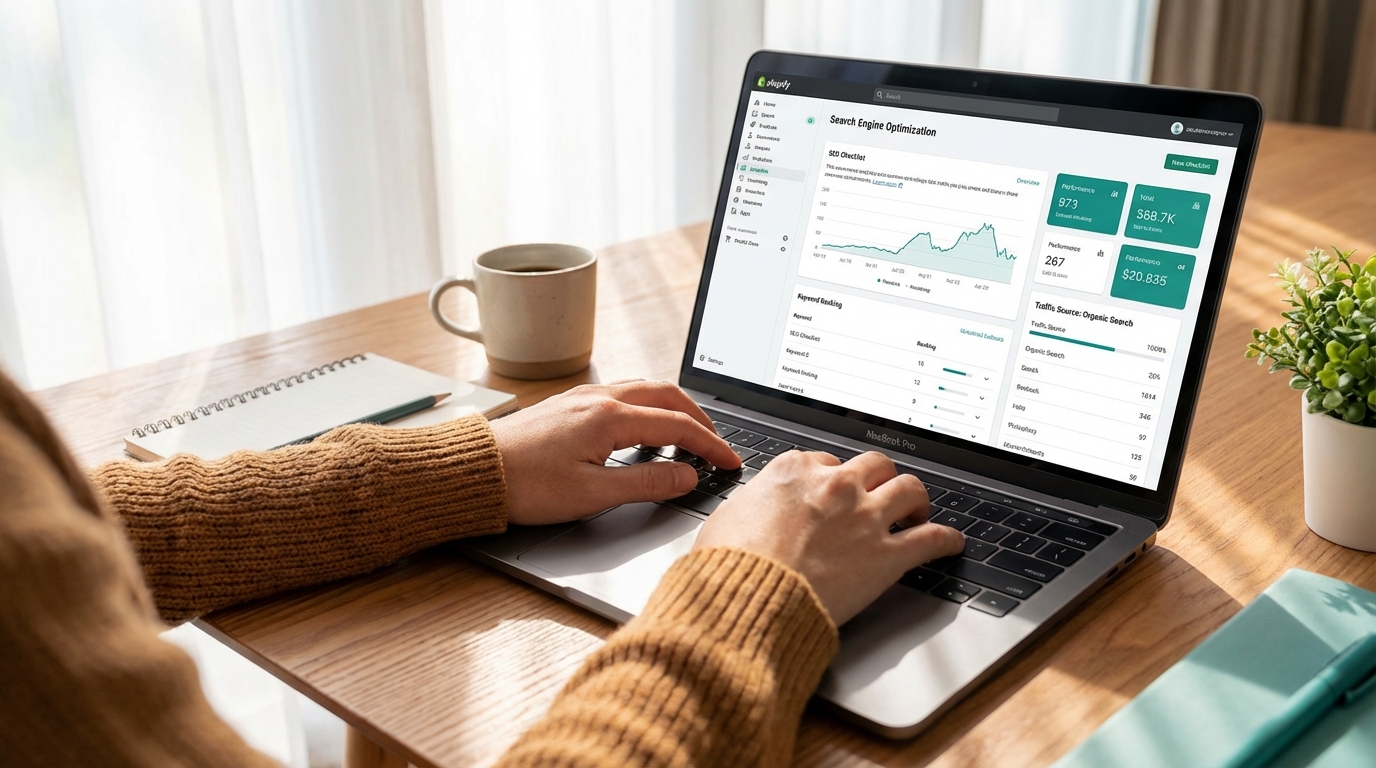
Shopify SEO in 2026 means optimizing for AI-powered search engines — ChatGPT, Perplexity, Google AI Overviews, Claude, and Grok — not just traditional Google. Your customers ask AI for product recommendations, which is why investing in shopify seo services has become essential. If your store isn't technically structured for AI crawlers to parse, you're invisible.
This guide is for Shopify store owners who want revenue from organic search, not vanity metrics. You'll learn the technical optimization strategies that make your products discoverable in AI-powered search results.
We'll cover:
- Schema markup implementation that AI crawlers can actually read
- Collection page strategy for transactional keywords
- Technical SEO fixes specific to Shopify's platform architecture
- Reddit authority building for AI visibility
- How to monitor whether AI models recommend your brand
Why Traditional Shopify SEO Doesn't Work in 2026
Most shopify seo agency advice still focuses on blog posts, backlinks, and meta descriptions. That worked in 2018. It doesn't work now.
AI models like ChatGPT and Perplexity can't parse JavaScript-rendered content the way Google can. Most Shopify stores render product data client-side through JavaScript. AI crawlers hit your page, see a blank skeleton, and move on. You're invisible to the systems making product recommendations to millions of users daily.
Google AI Overviews, ChatGPT, and Perplexity pull heavily from Reddit when answering product recommendation queries. If your brand has zero presence on Reddit, you're not showing up in AI-generated shopping lists. Traditional SEO agencies don't build Reddit authority. They write blog posts and chase backlinks.
Revenue comes from transactional keywords — "best waterproof hiking boots," "organic dog food for sensitive stomachs," "minimalist wallets for men." Those searches happen on collection pages, not blog posts. Yet most agencies still push content marketing as the primary SEO strategy for ecommerce.
Step 1: Implement Schema Markup That AI Crawlers Can Parse
Schema markup is structured data that tells search engines exactly what your page contains. AI models rely on schema more heavily than traditional crawlers because they need parseable, structured information to generate accurate recommendations.
According to Shopify's official blog in 2026, free Shopify themes automatically include structured data for product pages, enabling rich snippets that display price, availability, and ratings. Custom themes and third-party themes often don't include this by default.
Check If Your Theme Has Schema Markup
View your product page source code. Search for "application/ld+json". If you see a JSON-LD block with Product schema, you're set. If not, you need to add it manually or switch themes.
Required Schema Types for Shopify Stores
Product schema is table stakes. You also need:
- Organization schema for your brand entity
- BreadcrumbList schema for site structure
- AggregateRating schema if you have reviews
- Offer schema with price, availability, and currency
AI crawlers use Organization schema to understand brand identity. BreadcrumbList helps them map your site architecture. Without these, AI models struggle to contextualize your products within your brand.
Schema Markup for Collection Pages
Collection pages need CollectionPage schema and ItemList schema. Most Shopify themes don't include this. You'll need to add it through your theme's liquid files or use a custom schema app.
ItemList schema tells AI crawlers that your collection page contains a curated list of products. This makes your collections eligible for AI-generated shopping recommendations when users ask for product category suggestions.
Step 2: Build Revenue-Generating Collection Pages
Collection pages are where ecommerce SEO revenue happens. They target transactional keywords with commercial intent. A well-optimized collection page for "organic dog food for sensitive stomachs" will generate more revenue than 50 blog posts about dog nutrition.
Identify Transactional Keywords
Use Google Keyword Planner or any keyword research tool to find product category searches with commercial intent. Look for keywords that include:
- Product type + modifier (e.g., "minimalist wallets for men")
- Product type + use case (e.g., "running shoes for flat feet")
- Product type + feature (e.g., "waterproof hiking boots")
- Best/top + product type (e.g., "best organic dog food")
Avoid informational keywords like "how to choose hiking boots." Those belong on blog posts. Collection pages target buying intent.
Create Dedicated Collection Pages for Each Keyword
Don't stuff multiple keywords onto one collection page. Build separate collections for "men's minimalist wallets," "women's minimalist wallets," and "RFID minimalist wallets." Each targets a distinct search query.
Shopify lets you create automated collections based on product tags, vendor, price, or inventory. Use this to scale collection page creation without manually curating every list.
Optimize Collection Page Content
Add 150-300 words of unique content above the product grid. Answer the search query directly in the first sentence. Then provide context — who this collection is for, what problems these products solve, and why your curation matters.
Include your target keyword in the collection title, URL, and meta description. Don't keyword-stuff. Write naturally.
Internal Linking Structure
Link related collections to each other. If you have a "waterproof hiking boots" collection, link to "winter hiking boots," "lightweight hiking boots," and "hiking boots for women" within the collection description.
Internal links help search engines understand topical relationships. They also help users discover related products, which increases time on site and conversion rate.
Get your products mentioned in ChatGPT
We'll show you exactly where AI search is recommending your competitors instead of you.
Step 3: Fix Shopify's Technical SEO Limitations
Shopify is a hosted platform. You don't control server configuration or core architecture. This creates specific technical SEO challenges that require workarounds, which is why working with an seo shopify expert can be invaluable.
Canonical URL Issues
Shopify automatically adds canonical tags to product pages. If a product appears in multiple collections, Shopify canonicalizes all URLs to the first collection the product was added to. This can hurt SEO if your primary collection isn't the canonical version, which is why working with a best shopify seo agency can help you manage these technical issues effectively.
Solution: Edit your theme's product template to set custom canonical URLs. Point the canonical to your highest-priority collection for each product.
Pagination and Faceted Navigation
Collection pages with filters (faceted navigation) create duplicate content issues. Shopify doesn't automatically handle this well. Filtered URLs like /collections/shoes?filter=size-10 aren't canonicalized properly.
Solution: Add canonical tags to filtered collection pages pointing back to the unfiltered collection URL. Use robots meta tags to noindex filtered pages if they don't provide unique value.
Image Optimization
Large image files slow page speed. Slow pages hurt search rankings and conversion rates. Shopify's image CDN helps, but you still need to upload optimized images.
Compress images before uploading. Use WebP format where possible. Add descriptive alt text to every image — this helps accessibility and image search visibility, as demonstrated in our roofnest case study.
Shopify automatically generates multiple image sizes for responsive display. Don't override this with custom code unless you know what you're doing.
Core Web Vitals Optimization
Google uses Core Web Vitals as a ranking factor. Shopify themes vary widely in performance. Test your site with Google PageSpeed Insights. Focus on:
- Largest Contentful Paint (LCP) — should be under 2.5 seconds
- First Input Delay (FID) — should be under 100 milliseconds
- Cumulative Layout Shift (CLS) — should be under 0.1
Common fixes: lazy-load images below the fold, minimize third-party scripts, use a performance-optimized theme, enable Shopify's native lazy loading for images.
URL Structure
Shopify's default URL structure includes /products/ and /collections/ prefixes. You can't remove these without custom development. Don't worry about it. Clean URLs matter less than content quality and schema markup.
Do customize your product and collection handles. Instead of /products/product-12345, use /products/organic-dog-food-sensitive-stomach. Descriptive URLs help users and search engines understand page content.
Step 4: Build Reddit Authority for AI Visibility
OpenAI, Anthropic, and Google all pull from Reddit when generating product recommendations. ChatGPT cites Reddit threads in shopping-related queries. Perplexity surfaces Reddit discussions in product comparison results. Google AI Overviews quote Reddit users.
If your brand has zero Reddit presence, you're invisible in AI-powered product recommendations. Traditional SEO agencies don't build Reddit authority. They focus on backlinks and blog posts.
Identify Relevant Subreddits
Find subreddits where your target customers ask for product recommendations. If you sell hiking gear, monitor r/CampingandHiking, r/Ultralight, r/WildernessBackpacking. If you sell skincare, monitor r/SkincareAddiction, r/30PlusSkinCare.
Don't spam. Reddit users hate overt marketing. You're building authority, not running ads.
Contribute Genuine Value
Answer questions. Share expertise. When someone asks "what's the best waterproof hiking boot for wide feet," provide a thoughtful answer based on your product knowledge. Mention your brand naturally if it's genuinely relevant.
Build karma in relevant subreddits before mentioning your products. Establish yourself as a helpful community member first. Reddit users can smell a shill from miles away.
Seed Product Mentions Organically
When your brand comes up organically in discussions, engage authentically. If someone asks about your product, provide helpful information. Don't hard-sell.
AI models scrape Reddit threads for product sentiment and recommendations. Positive organic mentions in relevant subreddits increase the likelihood that ChatGPT or Perplexity will recommend your brand when users ask for product suggestions.
Step 5: Monitor AI Visibility Across ChatGPT, Perplexity, and Google AI Overviews
You can't optimize what you don't measure. Traditional SEO tools track Google rankings. They don't track whether ChatGPT recommends your brand when users ask for product suggestions.
Manual AI Visibility Testing
Run product recommendation queries in ChatGPT, Perplexity, Google AI Overviews, Claude, and Grok. Test queries like:
- "What's the best [product category] for [use case]?"
- "Recommend [product type] for [customer persona]"
- "Where can I buy [product feature + product type]?"
Track whether your brand appears in AI-generated recommendations. Track positioning — are you the first recommendation or the fifth? Track context — does the AI cite accurate information about your products?
Track Changes Over Time
Run the same queries monthly. Monitor whether your AI visibility improves as you implement schema markup, build collection pages, and establish Reddit authority.
AI models update regularly. Your visibility can change as models retrain on new data. Consistent monitoring helps you understand what's working.
Competitive AI Visibility Analysis
Test the same queries for your competitors. If ChatGPT recommends three competitor brands but not yours, you have an AI visibility problem. Analyze their schema markup, Reddit presence, and collection page strategy to identify gaps in your approach.
Step 6: Optimize Product Pages for Search Engines
Product pages need technical optimization beyond schema markup. Most Shopify stores neglect basic on-page SEO because they focus on product photography and descriptions.
Title Tags and Meta Descriptions
Shopify auto-generates title tags from product titles. Customize them. Include your primary keyword and a benefit-driven modifier.
Instead of "Men's Minimalist Wallet - Black," use "Men's Minimalist Wallet - RFID Blocking Leather - Slim Design." The second version targets more specific search queries and communicates product benefits.
Meta descriptions don't directly impact rankings, but they affect click-through rate. Write compelling meta descriptions that include your keyword and a clear value proposition. Keep them under 160 characters.
Product Descriptions
Write unique product descriptions. Don't copy manufacturer descriptions. AI crawlers and Google both penalize duplicate content.
Structure product descriptions for scannability. Use short paragraphs, bullet points, and bolded key features. Most users skim product pages. Make important information easy to find.
Include your target keyword naturally in the first 100 words. Don't keyword-stuff. Write for humans first, search engines second.
User-Generated Content
Product reviews provide fresh, unique content that search engines value. Reviews also provide social proof that increases conversion rates.
Use a Shopify review app that implements AggregateRating schema. This enables star ratings in search results, which increases click-through rate.
Step 7: Create a Sitemap and Submit to Google Search Console
Shopify automatically generates an XML sitemap at yourstore.com/sitemap.xml. This sitemap includes all your products, collections, pages, and blog posts.
Submit your sitemap to Google Search Console. This helps Google discover and index your pages faster. It also provides data on indexing errors, mobile usability issues, and Core Web Vitals performance.
Monitor Search Console Data
Check Google Search Console monthly. Review:
- Indexing coverage — are all your important pages indexed?
- Mobile usability — does your site work well on mobile devices?
- Core Web Vitals — are your pages fast enough?
- Manual actions — has Google penalized your site?
Fix issues as they arise. Indexing errors mean pages aren't showing up in search results. Mobile usability issues hurt rankings. Core Web Vitals problems slow your site and reduce conversions.
Step 8: Avoid Common Shopify SEO Mistakes
Most Shopify stores make the same SEO mistakes. Avoiding these puts you ahead of 80% of competitors.
Thin Content on Collection Pages
Don't leave collection pages as just product grids. Add unique content that explains what the collection is, who it's for, and why your curation matters. 150-300 words minimum.
Duplicate Product Descriptions
Don't copy manufacturer descriptions. Write unique descriptions for every product. AI crawlers and Google both penalize duplicate content.
Ignoring Alt Text
Add descriptive alt text to every image. This helps accessibility and image search visibility. Don't keyword-stuff alt text. Describe what the image shows.
Too Many Product Variants
Shopify treats product variants (size, color) as a single product. If you have 20 color variants, you have one product page, not 20. This is fine for SEO. Don't create separate products for each variant unless they're genuinely different products.
Neglecting Mobile Optimization
Over 60% of ecommerce traffic comes from mobile devices. If your site doesn't work well on mobile, you're losing sales and search rankings. Test your site on actual mobile devices, not just desktop browser emulators.
Frequently Asked Questions
How do I optimize my Shopify store for SEO?
Optimize your Shopify store for SEO by implementing schema markup that AI crawlers can parse, building revenue-generating collection pages around transactional keywords, fixing technical SEO issues specific to Shopify's platform, and establishing Reddit authority for AI visibility. Focus on making your products discoverable in AI-powered search engines like ChatGPT and Perplexity, not just traditional Google. Schema markup, collection page strategy, and Reddit presence matter more than blog posts and backlinks in 2026.
What are the 3 C's of SEO?
The 3 C's of SEO are Content, Code, and Credibility. Content means high-quality, relevant information that answers user queries. Code means technical optimization — site speed, mobile usability, schema markup, and clean URL structure. Credibility means authority signals like backlinks, brand mentions, and user engagement metrics. For ecommerce in 2026, add a fourth C: Crawlability for AI. Your content needs to be parseable by AI models, which means proper schema markup and server-side rendering instead of JavaScript-heavy themes.
Is Shopify still worth it in 2026?
Yes, Shopify is still worth it in 2026 for most ecommerce businesses. The platform handles hosting, security, payments, and core ecommerce functionality reliably. Shopify's free themes now include automatic schema markup for products, which helps AI visibility. The main limitation is technical SEO flexibility — you can't fully control server configuration or core architecture. For most brands, Shopify's ease of use outweighs these limitations. If you need complete technical control, consider headless Shopify or a custom solution.
Can ChatGPT do SEO?
ChatGPT can help with SEO tasks like keyword research, content outlining, and meta description writing, but it can't replace human SEO expertise. ChatGPT doesn't have real-time access to search data, can't analyze your site's technical performance, and doesn't understand your specific business context. Use ChatGPT as a research and writing assistant, not as your primary SEO strategy. The bigger question in 2026 is whether your SEO strategy accounts for ChatGPT as a search engine — millions of users ask ChatGPT for product recommendations instead of Googling. If your store isn't optimized for AI visibility, you're missing revenue.
Why Most Shopify SEO Advice Fails Ecommerce Brands
Most Shopify SEO guides recommend the same tactics: write blog posts, build backlinks, optimize meta descriptions, add alt text to images. These tactics aren't wrong. They're just incomplete for 2026.
Blog posts don't drive ecommerce revenue. Collection pages do. Backlinks from generic directories don't improve AI visibility. Reddit authority does. Meta descriptions don't help AI crawlers understand your products. Schema markup does.
Traditional SEO agencies sell services that worked in 2015. They haven't adapted to AI-powered search. They don't build collection pages. They don't implement schema markup properly. They don't establish Reddit presence. They don't monitor AI visibility.
SEOasis built its methodology specifically for AI-era ecommerce SEO. We focus on revenue-generating collection pages, schema markup that AI crawlers can parse, Reddit authority building, and AI visibility monitoring across ChatGPT, Perplexity, Google AI Overviews, Claude, and Grok. We don't write blog posts. We don't chase backlinks. We build technical infrastructure that makes your products discoverable in AI-powered search.
The Real Shopify SEO Strategy for 2026
Your customers are asking AI for product recommendations. ChatGPT, Perplexity, and Google AI Overviews are answering those questions. If your Shopify store isn't technically optimized for AI visibility, you're invisible in the fastest-growing search channel.
Focus on what actually drives revenue: collection pages targeting transactional keywords, schema markup that AI crawlers can parse, and Reddit authority that gets your brand cited in AI-generated recommendations. Traditional SEO tactics like blog posts and backlinks matter less than technical optimization for AI visibility.
SEOasis helps Shopify brands become visible in AI-powered search. We build revenue-generating collection pages, implement schema markup properly, establish Reddit authority, and monitor AI visibility across all major platforms. If you're tired of SEO agencies that overpromise and underdeliver, talk to us. We don't just tell you what you want to hear. We tell you what you need to hear.