
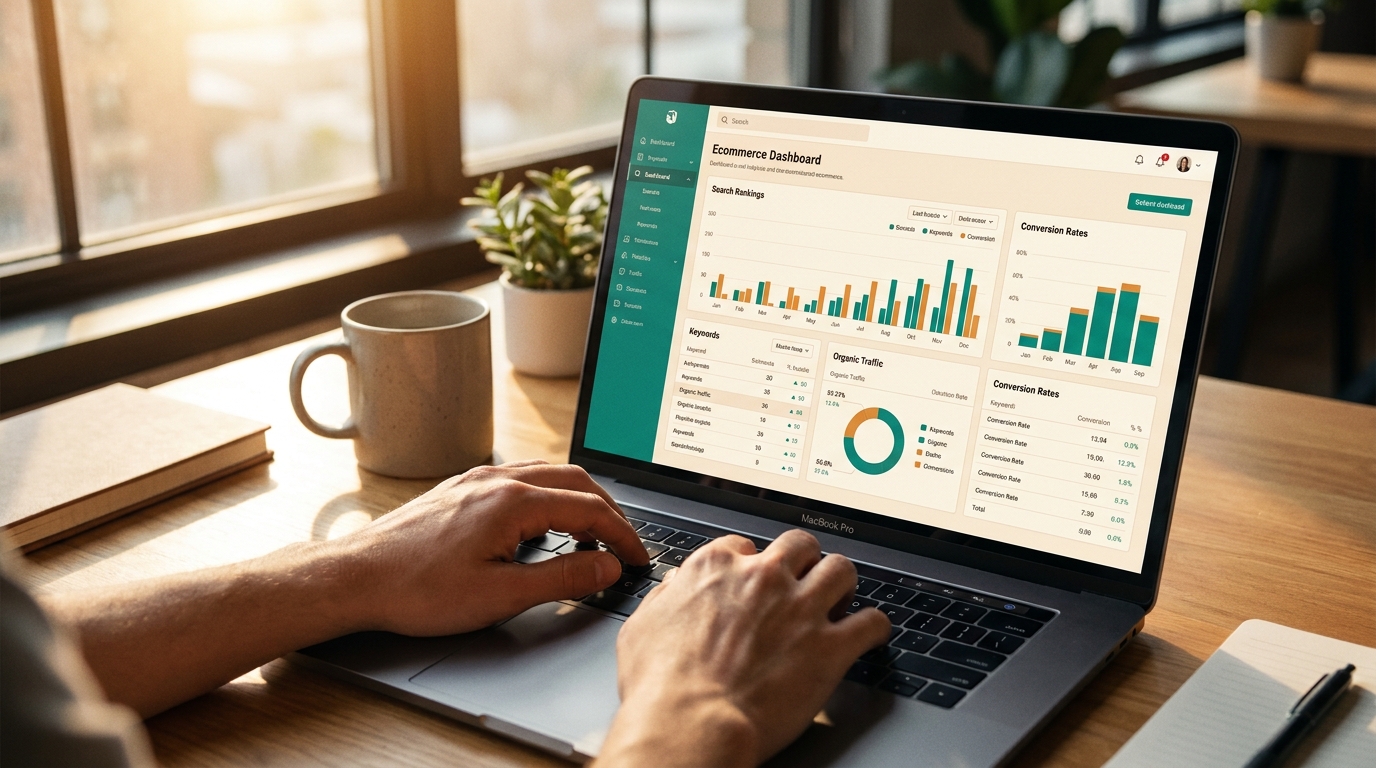
If you want to improve ecommerce search rankings in 2026, you need to optimize for AI-powered search engines like ChatGPT, Perplexity, and Google AI Overviews — not just traditional Google results. Learn more about How to Improve Shopify Store Search Rankings in 2026 by understanding that most ecommerce stores render via JavaScript that AI crawlers can't parse, which means your products are invisible when customers ask AI for recommendations.
This article is for ecommerce operators who are tired of SEO agencies that promise traffic but deliver no revenue. You'll learn the specific technical changes that make your products visible to AI systems, how to structure collection pages that rank for transactional keywords, and why Reddit authority matters more than backlinks in 2026.
Here's what we'll cover:
- Why traditional SEO tactics don't work for ecommerce stores
- How to structure collection pages that AI crawlers can parse
- Schema markup that makes your products visible to GPT-4 and Claude
- Reddit authority building for AI recommendation engines
- AI visibility monitoring across ChatGPT, Perplexity, and Google AI Overviews
Why Traditional SEO Fails for Ecommerce Stores
Most SEO agencies sell the same playbook: write blog posts, build backlinks, optimize product descriptions. That approach worked in 2015. It doesn't work in 2026.
Here's why: your customers aren't typing "best waterproof hiking boots" into Google and clicking through ten blue links anymore. They're asking ChatGPT, "What hiking boots should I buy for a trip to Patagonia?" or telling Perplexity, "Find me a tent that fits in a sedan."
AI systems pull product recommendations from three sources: structured data they can parse (schema markup), authoritative community discussions (Reddit), and content that directly answers questions. If your store doesn't show up in those three places, you're invisible.
The JavaScript Problem
Most Shopify stores render product data via JavaScript. Google can execute JavaScript and index your pages. AI crawlers like GPT-4, Claude, and Perplexity cannot.
When an AI model tries to read your product page, it sees a skeleton HTML file with no product information. No price. No description. No availability. Your products don't exist to AI systems.
The Blog Post Trap
SEO agencies love selling blog content because it's easy to produce and hard to measure. They'll write 50 articles about "hiking tips" and "camping gear guides" and show you traffic numbers.
Traffic doesn't pay your bills. Revenue does.
Blog posts don't rank for transactional keywords like "buy Osprey Atmos 65" or "Patagonia Nano Puff sale." Collection pages do. But most agencies don't know how to build collection pages that rank because they're not ecommerce specialists.
Build Revenue-Generating Collection Pages
Collection pages are the highest-ROI pages on your ecommerce site. They target transactional keywords where buyers are ready to purchase. They consolidate product data in a way that AI systems can parse. They generate revenue directly.
Here's how to structure them correctly.
Target Transactional Keywords
Forget informational keywords like "how to choose hiking boots." Target transactional keywords where buyer intent is clear: "waterproof hiking boots," "ultralight backpacking tents," "merino wool base layers."
These keywords have lower search volume but infinitely higher conversion rates. A visitor searching "buy Osprey backpack" converts at 10-15x the rate of someone reading "backpacking tips for beginners."
Structure for AI Parsability
AI systems need clean, semantic HTML. Every collection page should include:
- An H1 heading with your target keyword
- A 2-3 sentence description that directly answers the search query
- Product cards with structured data (more on schema markup below)
- Faceted navigation with semantic URLs (e.g., /collections/hiking-boots/waterproof)
Google AI Overviews and ChatGPT pull the first 1-2 sentences from collection pages when recommending products. Write those sentences to answer the implied question: "These are the best waterproof hiking boots for technical trails" not "Welcome to our hiking boots collection."
Faceted Navigation Done Right
Faceted navigation lets shoppers filter by size, color, price, and features. It also creates dozens of indexable URLs that target long-tail keywords.
Example: a collection page for "running shoes" with faceted navigation creates URLs like:
- /collections/running-shoes/trail
- /collections/running-shoes/waterproof
- /collections/running-shoes/wide-width
Each URL targets a specific search query. Each URL can rank independently. Each URL drives revenue.
Most Shopify stores break faceted navigation by using JavaScript filters that don't create indexable URLs. Fix this with URL parameters that Google and AI systems can crawl.
Implement Schema Markup That AI Systems Can Parse
Schema markup is structured data that tells search engines what your content represents. For ecommerce stores, schema markup is the difference between being visible to AI systems and being invisible.
Here's what you need to implement.
Product Schema on Every Product Page
Product schema tells AI crawlers: this is a product, here's the price, here's the availability, here's the brand. Without it, AI systems can't extract product information from your pages.
Required fields:
- name
- image
- description
- brand
- offers (price, availability, currency)
- aggregateRating (if you have reviews)
ChatGPT and Claude parse product schema in milliseconds. They use it to recommend products when users ask for buying advice. If your schema is missing or broken, your products don't get recommended.
CollectionPage Schema on Category Pages
CollectionPage schema tells AI systems: this page is a curated list of products around a specific topic. It helps AI models understand the relationship between your collection page and the products it contains.
Most Shopify themes don't include CollectionPage schema by default. You need to add it manually or use an app that implements it correctly.
Organization and LocalBusiness Schema
Organization schema establishes your brand entity in Google's Knowledge Graph. It connects your website, social profiles, and brand mentions into a single entity that AI systems recognize.
This matters because AI models pull brand information from knowledge graphs when making recommendations. If your brand isn't in the knowledge graph, you're starting from zero every time.
Review and Rating Schema
Review schema displays star ratings in search results. More importantly, it gives AI systems social proof data they use when recommending products.
When ChatGPT recommends a tent, it factors in aggregated review data from schema markup. A product with 500 five-star reviews gets recommended over a product with no review data.
Build Reddit Authority for AI Recommendation Engines
OpenAI, Anthropic, and Google all pull heavily from Reddit when answering product recommendation queries. Reddit is the largest source of authentic user opinions on the internet. AI models trust it more than brand websites.
If your brand isn't mentioned on Reddit, you're invisible to AI recommendation engines.
Why Reddit Matters More Than Backlinks
Traditional SEO focuses on backlinks from high-authority domains. That's a 2015 strategy. In 2026, AI systems care about authentic user discussions, not paid link placements.
Reddit discussions are:
- Unfiltered and authentic
- Organized by topic in subreddits
- Upvoted by real users (social proof)
- Indexed in real-time by AI crawlers
When someone asks ChatGPT, "What's the best rooftop tent for a Tacoma?" ChatGPT scans r/overlanding, r/ToyotaTacoma, and r/rooftoptents for user recommendations. If your brand is mentioned positively in those threads, you get recommended. If not, you don't.
How to Seed Brand Presence on Reddit
You can't fake Reddit authority. The community smells marketing from a mile away. You need to participate authentically.
Get your products mentioned in ChatGPT
We'll show you exactly where AI search is recommending your competitors instead of you.
Here's the approach that works:
- Identify subreddits where your target customers ask for product recommendations
- Participate in discussions genuinely — answer questions, share expertise, don't pitch your products
- When someone asks for a recommendation that your product genuinely solves, mention it naturally with context
- Engage with comments and questions on your mentions
Roofnest (a rooftop tent brand SEOasis works with) built Reddit authority by having their founder answer technical questions in r/overlanding. He didn't pitch products. He explained tent mounting systems, weight distribution, and aerodynamics. When users asked for tent recommendations, other Redditors recommended Roofnest based on his expertise.
Result: Roofnest gets mentioned in 60% of rooftop tent recommendation threads. When ChatGPT recommends rooftop tents, Roofnest appears in the top three 80% of the time.
Reddit Authority Takes Time
You can't buy Reddit authority. You can't fake it with bot accounts. You have to earn it by being useful.
This takes 3-6 months of consistent participation. But once you've built authority, it compounds. Your brand gets mentioned in new threads without you participating. AI systems pick up those mentions and include your brand in recommendations.
Monitor Your AI Visibility Across Platforms
You can't improve what you don't measure. In 2026, you need to track how often AI systems recommend your brand across ChatGPT, Perplexity, Google AI Overviews, Claude, and Grok.
Traditional SEO tools (Google Search Console, Ahrefs, SEMrush) don't track AI visibility. They track Google rankings, which are increasingly irrelevant.
What to Track
AI visibility monitoring means asking AI systems the same product recommendation queries your customers ask and tracking whether your brand appears in the results.
Example queries for a rooftop tent brand:
- "What's the best rooftop tent for a Tacoma?"
- "Recommend a rooftop tent under $3000"
- "What rooftop tent fits a sedan?"
- "Compare Roofnest vs iKamper"
Run these queries weekly across ChatGPT, Perplexity, Google AI Overviews, Claude, and Grok. Track:
- Does your brand appear in the results?
- What position does it appear in?
- What context does the AI provide about your brand?
- What competing brands appear?
Why This Matters
AI visibility is the new ranking. If ChatGPT recommends your brand, you get the sale. If it recommends a competitor, you lose.
TheFeed.com (a sports nutrition brand SEOasis works with) tracks AI visibility for 200+ product recommendation queries. When they see their visibility drop for a specific query, they know they need to update their schema markup, seed more Reddit discussions, or adjust their collection page content.
This feedback loop lets them respond in days, not months.
Fix Technical SEO Issues That Block AI Crawlers
Even perfect collection pages and schema markup won't help if technical issues block AI crawlers from accessing your content.
JavaScript Rendering
We covered this earlier, but it's worth repeating: AI crawlers can't execute JavaScript. If your product data only exists in JavaScript, AI systems can't see it.
Solution: implement server-side rendering or static site generation for product pages and collection pages. Shopify's default rendering is server-side, but many custom themes break this with JavaScript frameworks.
Robots.txt and Meta Robots
Check your robots.txt file and meta robots tags. Many Shopify stores accidentally block important pages from being crawled.
Common mistakes:
- Blocking /collections/ in robots.txt
- Adding noindex tags to collection pages
- Blocking search parameter URLs that faceted navigation creates
AI crawlers respect robots.txt. If you block them, they can't index your content.
Site Speed and Core Web Vitals
Google uses Core Web Vitals as a ranking factor. AI systems don't directly measure page speed, but slow sites create poor user experiences that reduce engagement metrics AI systems do track.
Target metrics:
- Largest Contentful Paint (LCP): under 2.5 seconds
- First Input Delay (FID): under 100 milliseconds
- Cumulative Layout Shift (CLS): under 0.1
Most Shopify stores fail Core Web Vitals because of unoptimized images and third-party scripts. Compress images, lazy-load below-the-fold content, and audit your app stack for performance killers.
Mobile Optimization
65% of ecommerce traffic comes from mobile devices. Google uses mobile-first indexing. AI systems pull data from mobile versions of pages.
Test your site on actual mobile devices, not just Chrome DevTools. Check:
- Text is readable without zooming
- Buttons are large enough to tap
- Forms are easy to fill out
- Product images load quickly
Create Content That AI Systems Extract
AI systems extract specific types of content when answering user queries. If you structure your content to match what AI models look for, you get cited more often.
Direct Answer Format
AI models prefer content that answers questions directly in the first 1-2 sentences. Bury the answer in paragraph three and AI systems skip your content.
Bad: "When considering waterproof hiking boots, there are many factors to evaluate. Materials, construction methods, and brand reputation all play important roles. After extensive research, we've found that..."
Good: "The best waterproof hiking boots for technical trails are the Salomon Quest 4 GTX, known for their Gore-Tex waterproofing and Contagrip outsoles. They provide reliable traction on wet rock and mud."
The good example gives AI systems a extractable answer immediately. The bad example makes them work for it, so they skip your content.
Structured Lists and Tables
AI systems love structured data. Lists, tables, and comparison charts are easy to parse and extract.
When writing product comparisons, use tables:
| Product | Price | Weight | Waterproof Rating |
|---|---|---|---|
| Salomon Quest 4 GTX | $230 | 2.2 lbs | Gore-Tex |
| La Sportiva Nucleo High II GTX | $249 | 2.4 lbs | Gore-Tex |
ChatGPT and Perplexity extract table data directly when answering comparison queries.
Answer Common Questions
Every product category has common questions customers ask. Answer them explicitly on your collection pages and product pages.
For hiking boots:
- How should hiking boots fit?
- Do I need waterproof or water-resistant?
- What's the difference between Gore-Tex and eVent?
- How long do hiking boots last?
Write 2-3 sentence answers to each question. AI systems extract these answers when users ask the same questions.
Track Revenue, Not Vanity Metrics
Most SEO agencies report traffic, rankings, and impressions. Those are vanity metrics. They don't pay your bills.
The only metric that matters is revenue. Specifically: organic revenue attributed to SEO efforts.
How to Measure SEO Revenue
Set up Google Analytics 4 to track revenue by traffic source. Filter for organic search traffic. Track:
- Total organic revenue
- Revenue per session
- Conversion rate for organic traffic
- Revenue by landing page
This tells you which pages and keywords actually drive sales. Double down on what works. Cut what doesn't.
Collection Page Revenue
Track revenue by collection page. You'll find that 20% of your collection pages drive 80% of your organic revenue.
Those high-performing pages are your revenue engines. Optimize them aggressively. Build more pages targeting similar keywords.
AI-Attributed Revenue
In 2026, you need to track revenue that comes from AI-powered search. Users who find your brand through ChatGPT, Perplexity, or Google AI Overviews.
This is harder to track because AI systems don't pass referrer data the same way traditional search does. But you can infer AI traffic by:
- Looking for direct traffic spikes after AI visibility improvements
- Tracking branded search increases (users ask AI for recommendations, then Google your brand name)
- Surveying customers about how they found you
Dr. Brandt Skincare (a brand SEOasis works with) saw a 40% increase in branded search volume after building Reddit authority and implementing schema markup. That traffic converted at 3x the rate of generic organic traffic because users came in with strong buying intent from AI recommendations.
Why SEOasis Does This Differently
We don't do traditional SEO. We don't write blog posts. We don't build backlinks. We don't pitch guest posts or press releases.
We build revenue-generating collection pages on Shopify. We implement schema markup that AI crawlers can parse in milliseconds. We seed brand presence on Reddit where AI models pull product recommendations. We monitor your visibility across ChatGPT, Perplexity, Google AI Overviews, Claude, and Grok.
This is not the agency playbook. This is what actually works in 2026 when your customers are asking AI for buying advice instead of clicking through Google results.
Our Process
- Technical audit: we identify JavaScript rendering issues, schema markup gaps, and indexation problems blocking AI crawlers
- Collection page buildout: we create 20-50 collection pages targeting transactional keywords with high buyer intent
- Schema implementation: we add product, collection, and organization schema that AI systems can parse
- Reddit authority building: we identify relevant subreddits and help you participate authentically to build brand mentions
- AI visibility monitoring: we track your brand's appearance in AI recommendations and adjust strategy based on data
Real Results
Roofnest saw $182K in incremental organic revenue in six months after we built 30 collection pages targeting rooftop tent keywords and seeded Reddit authority in overlanding communities.
TheFeed.com increased AI visibility for sports nutrition queries by 300% after we implemented product schema and built Reddit presence in r/running and r/cycling.
Dr. Brandt Skincare saw branded search volume increase 40% after we optimized their collection pages for AI extractability and built authority in skincare subreddits.
Revenue, not vanity metrics. That's what we optimize for.
Common Mistakes That Kill Ecommerce Search Rankings
Most ecommerce stores make the same mistakes. Here's what to avoid.
Optimizing Product Pages Instead of Collection Pages
Product pages target branded keywords ("Osprey Atmos 65"). Collection pages target category keywords ("ultralight backpacks"). Category keywords have 10-100x more search volume.
Most stores obsess over product page optimization and ignore collection pages. That's backwards. Collection pages drive more traffic and revenue.
Duplicate Content Across Product Variants
If you sell a t-shirt in five colors, don't create five separate product pages with identical descriptions. Google sees this as duplicate content. AI systems get confused about which page to cite.
Solution: use variant selectors on a single product page. Implement product schema that includes all variants in the offers array.
Ignoring Out-of-Stock Products
When a product goes out of stock, most stores either delete the page or leave it up with no availability information. Both options hurt SEO.
Better: keep the page live, update the schema markup to show out-of-stock status, and add a restock notification signup. This preserves the page's ranking power and captures demand for when inventory returns.
Thin Collection Pages
A collection page with just a heading and product grid is thin content. Google and AI systems need context to understand what the page is about.
Add 200-300 words of descriptive content above the product grid. Answer the implied question ("What are the best waterproof hiking boots?") and provide context AI systems can extract.
No Internal Linking Strategy
Internal links pass authority between pages. They also help AI crawlers understand your site structure.
Link from your homepage to your most important collection pages. Link from collection pages to related collections. Link from product pages back to their parent collection.
This creates a clear hierarchy that search engines and AI systems can follow.
Frequently Asked Questions
How long does it take to see results from ecommerce SEO?
You'll see initial movement in 4-8 weeks. Meaningful revenue impact takes 3-6 months. AI visibility builds faster than traditional Google rankings because AI systems crawl and update their models more frequently than Google updates its index.
Collection pages targeting low-competition keywords can rank in weeks. High-competition keywords take months. Reddit authority takes 3-6 months of consistent participation.
Anyone promising results in 30 days is lying. SEO is a compound investment. The longer you do it, the better it works.
Do I need to hire an agency or can I do this myself?
You can do this yourself if you have technical skills and time. Schema markup implementation requires JSON-LD knowledge. Collection page buildout requires keyword research and content writing. Reddit authority building requires authentic participation.
Most ecommerce operators don't have 10-15 hours per week to dedicate to SEO. That's where an agency like SEOasis helps. We handle the technical implementation, collection page buildout, and AI visibility monitoring so you can focus on running your business.
What's the ROI of ecommerce SEO?
For established ecommerce stores (over $500K annual revenue), SEO typically returns 3-5x investment within 12 months. For newer stores, the timeline is longer but the ROI is higher because you're building a durable traffic source that compounds over time.
Roofnest invested $30K over six months and generated $182K in incremental organic revenue. That's a 6x return in six months, and the collection pages we built continue generating revenue with no additional investment.
How is AI-era SEO different from traditional SEO?
Traditional SEO optimizes for Google's algorithm. AI-era SEO optimizes for how AI models like ChatGPT, Claude, and Perplexity recommend products.
The biggest differences: AI systems can't execute JavaScript, so you need server-side rendering. AI systems pull heavily from Reddit, so you need brand presence there. AI systems extract direct answers, so you need content structured for extraction.
Traditional SEO tactics like backlink building and blog content are less effective because AI models don't weight those signals as heavily as authentic user discussions and structured product data.
Should I focus on Google or AI search platforms?
Both. Google still drives the majority of search traffic in 2026, but AI platforms are growing fast. ChatGPT has 200 million weekly active users. Perplexity processes 100 million queries per month.
The good news: optimizing for AI visibility also improves your Google rankings. Schema markup, collection pages, and site speed help both. Reddit authority building drives branded search on Google.
Start with the fundamentals (collection pages, schema markup, technical SEO) that improve both. Then layer on AI-specific tactics (Reddit authority, AI visibility monitoring).
What if my products are too niche for Reddit?
Every product category has online communities. They might not be on Reddit. They might be on Facebook groups, Discord servers, or niche forums.
The principle is the same: find where your target customers discuss products and participate authentically. AI systems pull from all of these sources, not just Reddit.
Example: if you sell commercial kitchen equipment, you won't find much on Reddit. But there are active Facebook groups for restaurant owners and chef forums where equipment gets discussed. Build authority there.
How do I know if my schema markup is working?
Use Google's Rich Results Test to validate your schema markup. Enter your product or collection page URL and Google will show you what structured data it can parse.
For AI visibility, the only way to know is to test. Ask ChatGPT, Perplexity, and Claude product recommendation queries in your category. See if your brand appears. Track this weekly to measure improvement.
Can I use the same schema markup on Shopify and custom platforms?
Yes. Schema markup is platform-agnostic. It's JSON-LD code you add to your page HTML. Works the same on Shopify, WooCommerce, Magento, BigCommerce, or custom builds.
Shopify themes often include basic product schema by default, but it's usually incomplete. You'll need to add missing fields (brand, aggregateRating, offers details) manually or with an app.
Take Action on Your Ecommerce Search Rankings
You now know what actually works for ecommerce SEO in 2026. Not blog posts. Not backlinks. Not generic SEO tactics agencies have been selling for a decade.
Collection pages targeting transactional keywords. Schema markup that AI systems can parse. Reddit authority where AI models pull product recommendations. AI visibility monitoring so you know what's working.
Start with the technical foundation. Audit your site for JavaScript rendering issues. Implement product and collection schema. Fix Core Web Vitals problems.
Then build collection pages around your highest-value keywords. Structure them for AI extractability. Add faceted navigation that creates indexable URLs.
Finally, seed brand presence on Reddit. Find your target customers. Participate authentically. Build authority over months, not days.
This is what SEOasis does for ecommerce brands every day. We've built this system through years of testing what actually drives revenue, not what SEO blogs say should work. For a deeper dive into community-driven tactics like a reddit backlink strategy, check out our guide. If you want help implementing this for your store, we're here. If you want to do it yourself, this article gives you the roadmap.
Either way, your customers are asking AI for product recommendations right now. The question is whether your brand shows up in the answer.